.svg)
.png?width=596&height=562&name=2x%20(1).png)
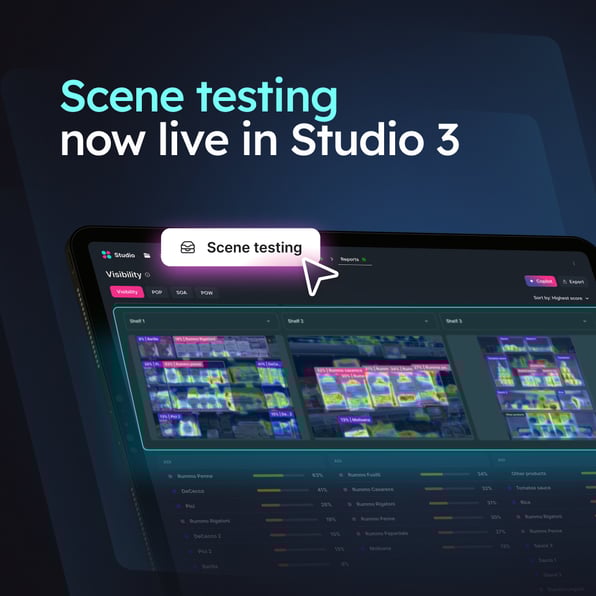
In today’s attention economy, success is not defined by how creative looks in isolation. It is defined by how it performs in the environments where people actually make decisions – on retail shelves, in-store displays, outdoor placements, and across ecommerce storefronts. That’s why we’ve launched scene testing in Dragonfly AI Studio 3.
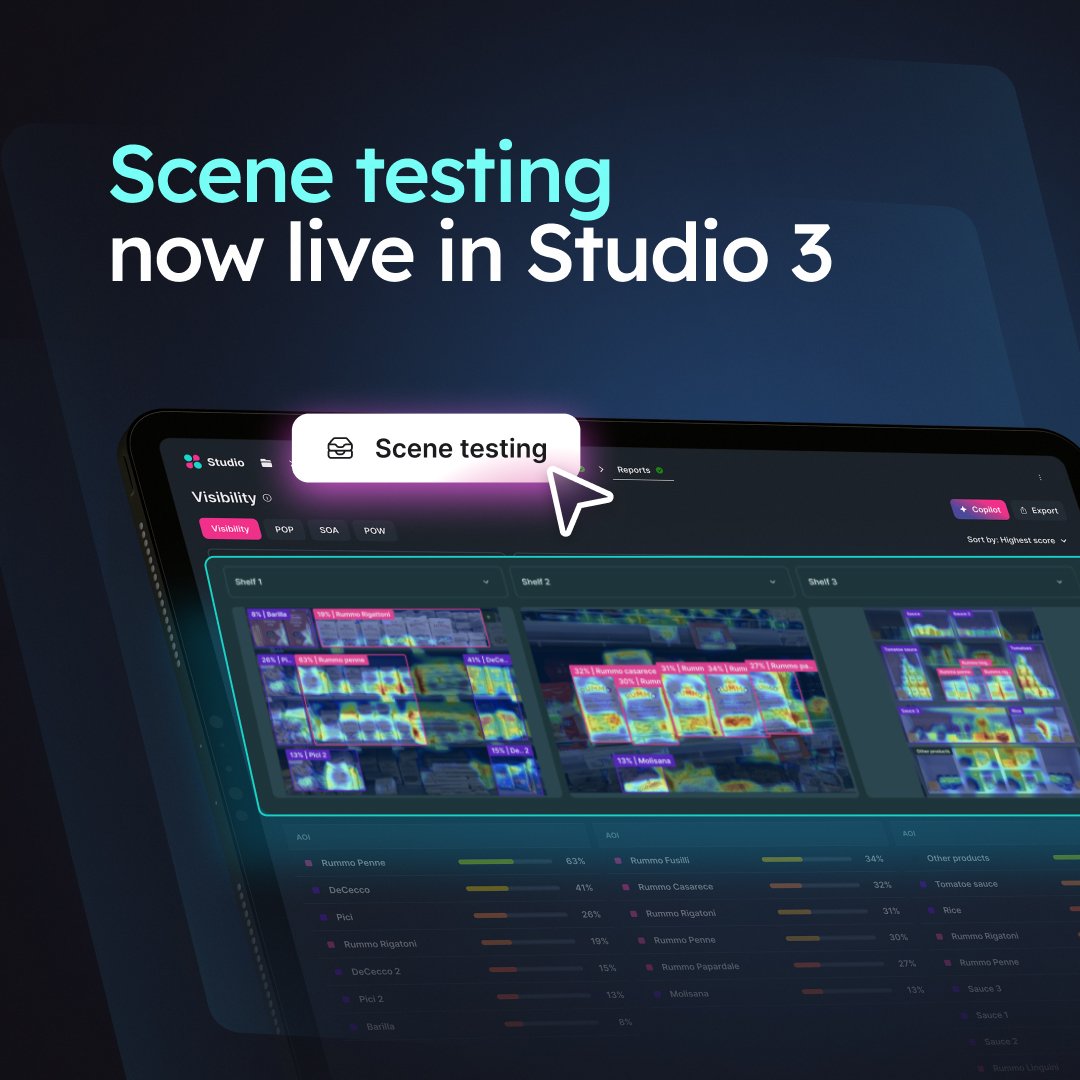
Scene testing is a new approach to in-context attention measurement, designed to help brands understand how multiple products, packaging designs, and shopper marketing assets perform within real or custom environments. It reflects a shift in workflow, moving from asset-led evaluation to environment-led insight.
From asset testing to scene testing: what’s changed?
Dragonfly AI has long enabled in-context testing through asset testing, including the ability to simulate how a single asset performs within a typical environment using tools like the visibility report. This has made it possible to understand how creative might perform beyond isolation.
However, real-world environments are not experienced one asset at a time.
Products compete side by side, packaging sits next to rival brands on a shelf, ads appear alongside other messages in outdoor spaces, and ecommerce listings are surrounded by alternatives, all competing for attention at the same moment.
Scene testing builds on this foundation by introducing a different way of working. Instead of starting with an asset and placing it into a simulated context, it starts with the environment itself and allows multiple assets to be analysed within it.
A scene-in approach to attention measurement
Scene testing is built around a ‘scene-in’ workflow. This means you begin with a real or custom environment, such as a retail shelf, planogram, point-of-sale display, outdoor placement, or ecommerce page, and then analyse how different assets perform within that specific context.
This shift matters because attention is shaped not just by the asset itself, but by everything around it. The surrounding products, colours, layouts, and visual noise all influence what gets noticed first.
By anchoring analysis in the scene, brands can evaluate performance in a way that more closely reflects real-world conditions.
Compare owned and competitor assets in a single competitive context
Traditional testing approaches often evaluate assets one at a time. Scene testing removes that constraint by enabling the comparison of multiple assets within a single environment.
Within the same scene, teams can measure how different executions perform side by side, including their own packaging designs, product variants, and promotional creative, as well as competitor products and messaging. This makes it possible to directly assess how well your brand stands out against the competition in the exact context where it will be seen.
This is particularly valuable in retail shelf testing, out-of-home advertising, and ecommerce optimisation, where success is defined by relative performance. It is not just about how visible your asset is, but whether it captures more attention than everything around it.
Measure real attention with visibility score
At the core of scene testing is Dragonfly AI’s visibility score, a proprietary metric designed to quantify how effectively an asset captures attention within a competitive visual environment.
Rather than simply identifying what is visible, visibility score measures what stands out in context. It reflects how quickly and clearly an area of interest draws attention compared to everything else in the scene, making it a powerful KPI for packaging testing, shopper marketing effectiveness, and ecommerce performance.
James Harvey, chief product and technology officer at Dragonfly AI, said: “Winning attention is the difference between being seen and being bought. Scene testing gives brands the ability to quantify visibility performance in real-world contexts, and optimise packaging, merchandising, and shopper creative with confidence before they ever go to market.”
Benchmark performance across environments
Performance is rarely consistent across contexts. A design that stands out in one store format or digital layout may fade into the background in another.
Scene testing allows brands to benchmark performance across multiple scenes, making it easier to understand how assets behave in different environments and identify where optimisation is needed. By comparing results across retail formats, store layouts, or ecommerce pages, teams can make more informed decisions and reduce the risk of underperformance at launch.
Built for real-world, competitive scenarios
Scene testing is designed for scenarios where context and competition are critical.
Whether evaluating a shelf layout, testing point-of-sale creative, analysing an out-of-home placement, or optimising an ecommerce product page, the ability to measure multiple assets within the same environment provides a more realistic and actionable view of performance.
It enables brands to test not just how their creative looks, but how it competes.
Bringing attention measurement closer to reality
With scene testing, attention measurement moves beyond isolated asset analysis and closer to how people actually experience the world.
By combining a scene-first workflow with multi-asset comparison and robust visibility metrics, Dragonfly AI enables brands to understand what truly captures attention in real environments and to optimise accordingly before going to market.
Because in competitive environments, it is not enough to be visible. You must win the scene.