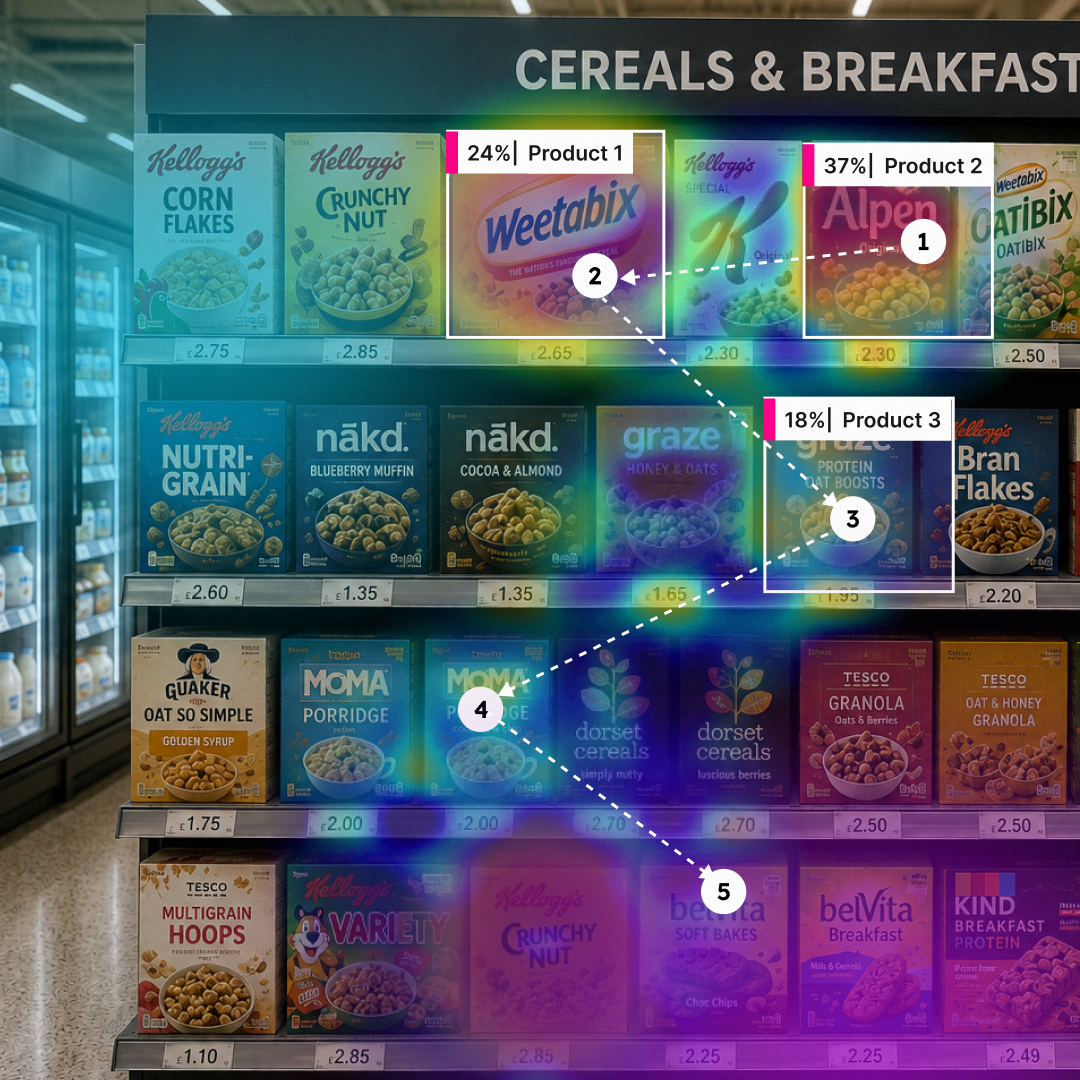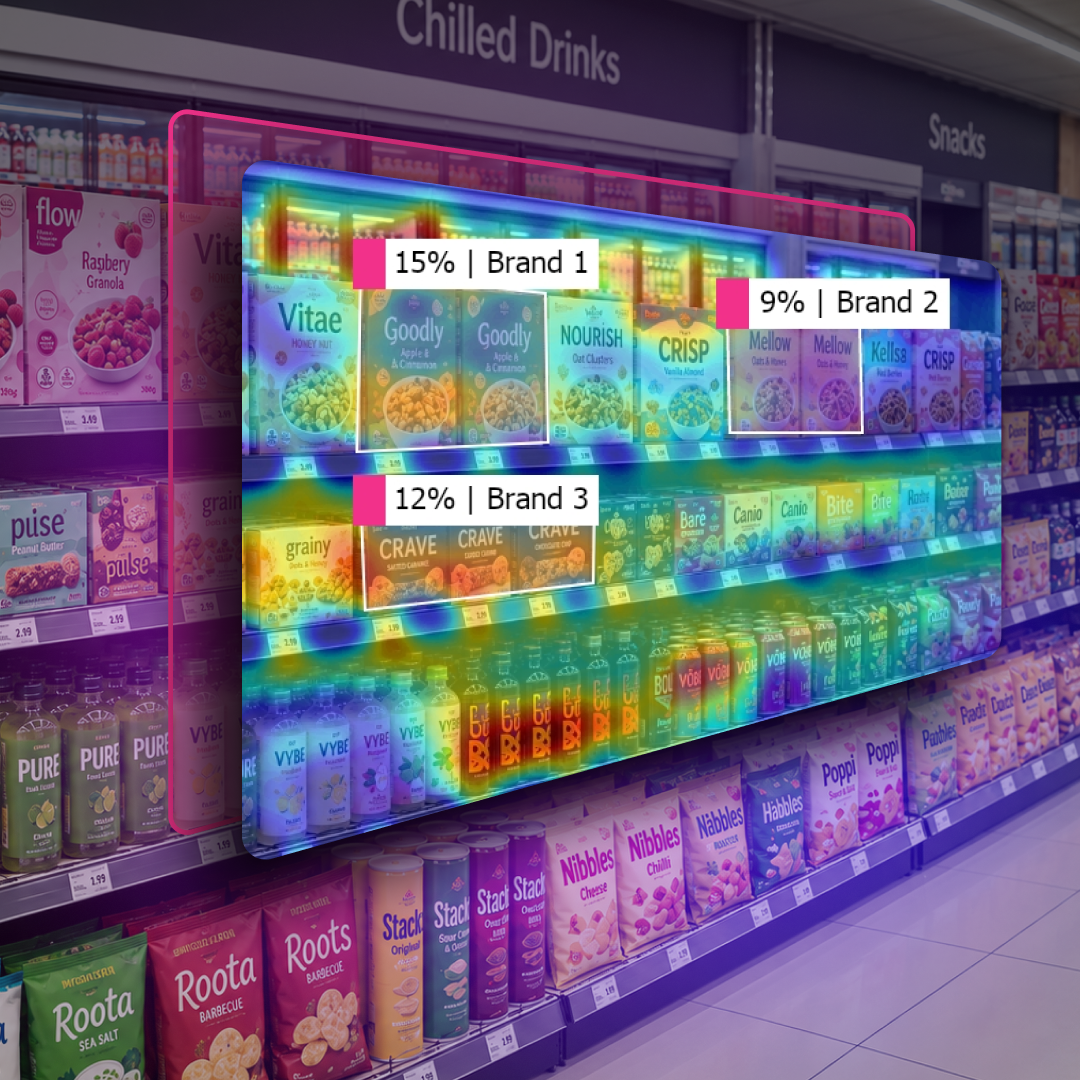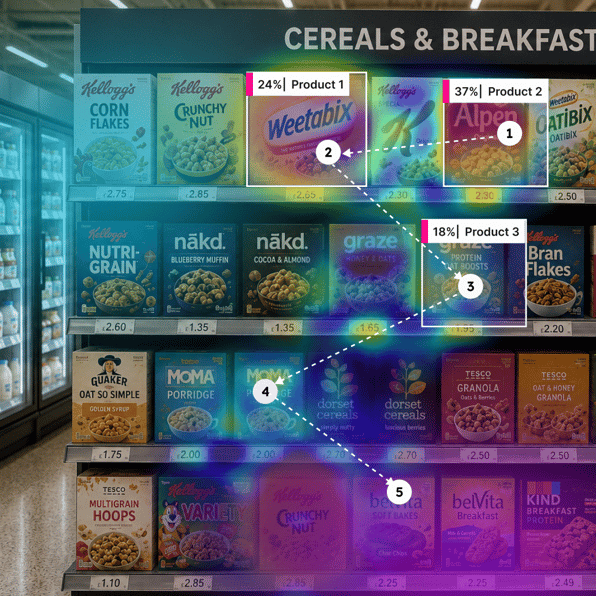

A shopper scans a UK supermarket shelf in a matter of seconds. A social feed moves even faster. Before any piece of creative can be remembered, felt, or acted on, it first has to be seen – and most of it isn't. Attention prediction is the branch of AI-powered creative measurement that forecasts what will and won't capture that first glance, before a single consumer ever sees the finished asset.
It's an increasingly common term in UK marketing and adtech circles, often used alongside – and sometimes confused with – saliency mapping, the specific technique most attention prediction models are built on. This guide explains what each term means and why the distinction matters in practice.
Attention prediction is AI that forecasts which parts of a piece of creative will capture visual attention, before it goes to market. It's built on saliency mapping, a technique that models the automatic, pre-cognitive visual processing the human brain performs in milliseconds – prioritising cues like orientation, colour, texture, and scale, none of which wins out on its own regardless of context. Unlike attention metrics measured after launch, it's a pre-market tool: it tells a brand where the eye is likely to go before any media spend is committed.
What attention prediction means
Attention is the first filter every piece of creative has to pass through. In competitive visual environments – a retail shelf, a social feed, an e-commerce page – the majority of creative is never consciously processed at all. Whether an asset gets seen is decided in milliseconds, by pre-cognitive mechanisms that operate before conscious evaluation begins.
Attention prediction models forecast that outcome computationally, from the creative itself, before launch. This is different from attention metrics such as viewability or dwell time, which are measured after an asset has already gone live and describe what happened rather than what will happen. Attention prediction is a pre-market tool: it tells a brand where the eye is likely to go before any media spend is committed, while after-the-fact metrics can only confirm the result once the budget has already been spent.
How saliency mapping works
Saliency mapping is the specific technique behind most attention prediction models. The human brain prioritises visual information using a small set of cues – orientation, colour, texture, and scale – and it does this automatically, before conscious thought. Crucially, no single cue always wins: the same bright red logo that jumps off a muted, mostly-grey shelf can disappear entirely against a background of equally bold colour and pattern. A saliency model has to simulate that dynamic competition between cues in context, not just detect strong cues in isolation.
In practice, that means the same design choice can help or hurt depending on what's around it. A large area of white space draws the eye when everything nearby is busy, but reads as empty and easy to skip past on a page that's already sparse. A face looking directly out of an image reliably pulls attention, but a face looking off to the side of the frame tends to pull the viewer's gaze with it, off the asset entirely. This context-dependence is exactly why attention can't be judged from a design brief or a gut check alone – it has to be modelled against the specific environment the creative will actually appear in.
Why attention prediction matters for UK brands
Creative quality accounts for an estimated 49–70% of advertising's incremental sales impact, according to research from NCSolutions, Google, and Sequent Partners – making it the single most powerful lever a marketer directly controls. But none of that quality matters if the creative is never seen in the first place, which is what makes attention the first and most fundamental thing to get right.
For UK brands, that pressure shows up most visibly on the physical retail shelf and in increasingly crowded social feeds, where dozens of competing assets are fighting for the same fraction of a second of visual attention. Used well, attention prediction lets a brand catch a problem – a logo that's getting lost, a headline that's competing with its own imagery – while it's still a design file, rather than finding out once the campaign is already live and the media spend has already gone.