.svg)

.png?width=596&height=562&name=2x%20(1).png)
Advent Calendars Are High-Stakes Creative Assets: Why Design Clarity Matters
By Kate Nunan, Principal Customer Success Manager, Dragonfly AI
Advent calendars used to be simple: a bit of chocolate, a countdown to Christmas, and a familiar fixture in the household. Today, they are something very different.
Across beauty, alcohol, coffee, pet care, and premium food, advent calendars have quietly become one of the most competitive and commercially important seasonal formats in retail. They are no longer novelty items for children, but high-value products designed to drive early demand, brand discovery, and serious revenue.
And yet, despite the stakes, many advent calendars are still designed and signed off without the same level of creative scrutiny applied to other high-impact assets.
Advent calendars as a strategic Q4 growth lever
The numbers tell only part of the story. The global advent calendar market is now worth over $1 billion and continues to grow year on year, with steady growth driven by premiumisation and category expansion. What is more interesting, however, is how brands and retailers are using the format.
Advent calendars increasingly act as an early trigger for the Christmas season. Shoppers research and buy them well ahead of December, often using them as justification to start festive spending earlier and spread the cost over time, particularly for higher-priced formats. For retailers, they drive footfall, pre-orders, and larger baskets. For brands, they offer a rare opportunity to secure attention and loyalty before peak trading even begins.
In many categories, particularly beauty and premium gifting, calendars now sell out before December arrives. That changes the role of the pack entirely. This is not just packaging; it is a headline seasonal asset that sets expectations for the brand’s entire Christmas range.
Designing for chaos, not the studio
If advent calendars are strategically important, they are also creatively unforgiving.
Small decisions have an outsized impact.
These products have to work in some of the most chaotic environments of the retail year: crowded Christmas aisles, overflowing gifting bays, and dense online ‘Christmas shops’.
Competition is intense, and attention is fleeting. On top of that, they are expected to communicate a huge amount of information at speed. Brand, value, theme, sustainability cues, age suitability, and gifting credentials are often all compressed onto a single front face.

In this context, success depends on what a shopper can see and understand in the first one to three seconds, before attention is pulled elsewhere. Does the pack stand out? Is the proposition clear? Is attention drawn to the right elements, or scattered across too many competing messages?
This is where advent calendar design differs from many other seasonal formats. You are not designing for considered browsing. You are designing for visual overload.
The hidden risk of long lead times
Another challenge is timing.
And timing changes everything. Advent calendars typically have long development cycles, often spanning 12 to 18 months.
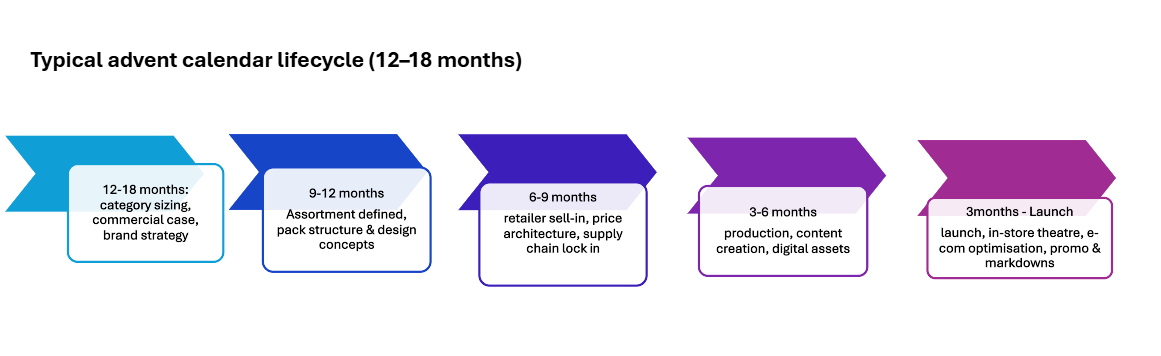
For a calendar launching in November next year, creative decisions are usually locked in before the current Christmas season has even finished. Once production is underway, there is little opportunity to course-correct without significant cost or delay. If the design does not cut through on shelf or fails to communicate value clearly, the commercial impact is felt for an entire season.
This makes early creative decisions disproportionately risky. A small misjudgement in hierarchy, messaging, or layout can have outsized consequences when multiplied across volume, price point, and brand visibility.
Why most advent calendars are still designed without evidence
Given the stakes, it would be reasonable to expect advent calendars to be rigorously tested. In practice, they rarely are.
Instead, many designs rely on internal opinion, historic precedent, or late-stage validation — when it is already too late to make meaningful changes. Traditional research methods can be slow, costly, and difficult to apply early enough in the process to shape direction rather than simply confirm decisions already made.
As a result, teams often default to what feels safe or familiar. The irony is that advent calendars are one of the formats where clarity and attention matter most, yet they are frequently treated as a creative leap of faith.
What good looks like in effective advent calendar design
While there is no single formula for success, there are consistent principles that separate effective advent calendar designs from those that struggle.
Strong calendars establish a clear visual hierarchy. There is an obvious focal point, and the eye is guided quickly to the most important information. Value is communicated immediately, whether that is through product count, premium cues, or a clear promise of discovery.
The best designs resist the temptation to say everything at once. They balance storytelling with simplicity, ensuring that brand and proposition are understood before secondary details compete for attention.
It is also worth remembering that advent calendars are experiential products. The interior layout, door design, and unboxing journey are part of the creative system. These elements influence how the product is shared socially and how the brand is remembered throughout December.
From a creative effectiveness perspective, these factors can be assessed through lenses such as attention, clarity, and digestibility, helping teams understand not just whether a design looks good, but whether it is likely to work under real-world conditions.
Shifting testing earlier in the cycle
One of the biggest opportunities for brands is to shift creative testing earlier, from late-stage sign-off in Q3 to learning in Q1 and Q2.
Testing routes, propositions, and claim hierarchies early allows teams to explore ideas while change is still possible. It also makes it easier to test designs in context, placing them into simulated Christmas aisles, gifting bays, or retailer.com layouts to see how they compete visually.
Over time, this approach helps organisations build internal benchmarks and playbooks for seasonal formats. Instead of reinventing the wheel each year, teams can codify what good looks like at different price tiers and use those insights to guide future development.
This is an area where AI-based creative analysis can play a valuable role, providing fast, scalable insight early in the process without slowing down the creative workflow.
Beyond advent: applying learnings across seasonal ranges
The value of these insights does not stop with advent calendars.
Many of the same principles apply to tins, gift packs, beauty sets, and bundled seasonal products. Learning what captures attention, communicates value, and drives clarity in one format can influence an entire seasonal pipeline.
Advent calendars can therefore act as a testing ground.
They help brand, shopper, design, and e-commerce teams align around evidence-based creative decisions that carry through into other high-impact assets.
Treat advent calendars like the high-stakes assets they are
Advent calendars are no longer side projects or festive novelties. They are commercial, creative, and reputational bets made months in advance, in one of the most competitive retail environments of the year.
Treating them with the same rigour as other major brand assets means starting earlier, designing for real-world chaos, and grounding creative decisions in evidence rather than assumption.
For teams willing to do that, advent calendars can become more than a countdown to Christmas. They can be a powerful driver of early demand, brand discovery, and seasonal success.
If this resonates, now is the right time to start earlier conversations about how seasonal creative is designed, evaluated, and learned from.
To see how creative testing can help, book a demo today.