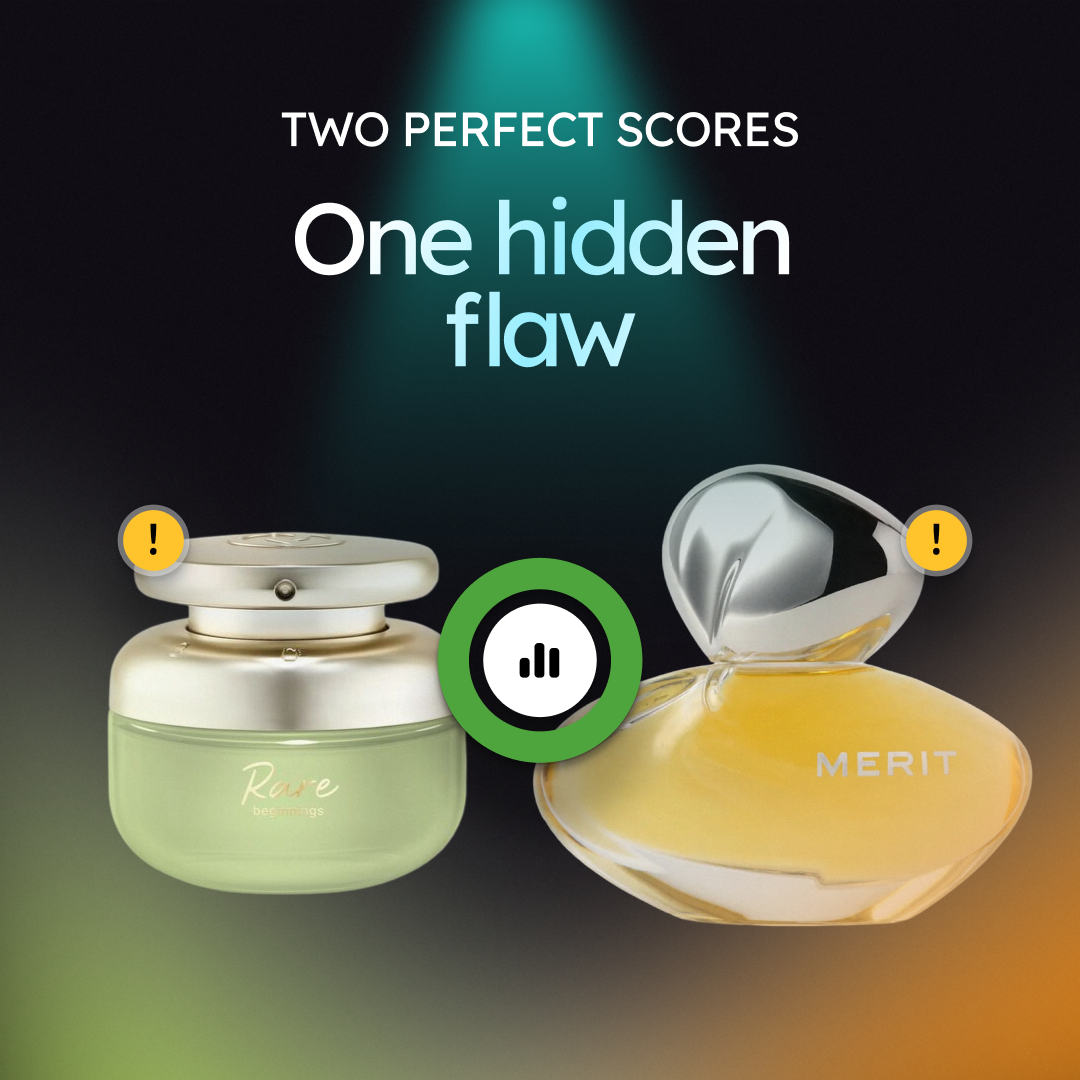


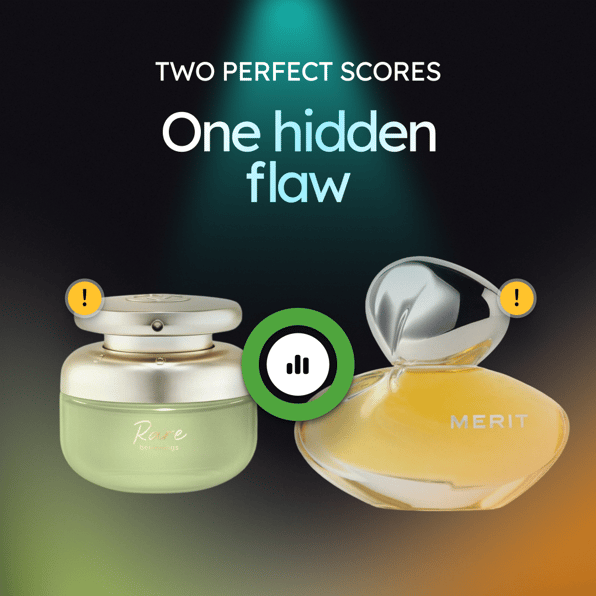

Over the past few months, two makeup-first brands have followed their debut fragrance with a second scent: Merit Beauty's New Wave Extrait de Parfum and Rare Beauty's Rare Beginnings. Both lean into the same minimalist, quiet-luxury photography that's become the default for this kind of launch – a single bottle, isolated against a clean background, with almost nothing else competing for the eye.
We ran both packs through Studio, Dragonfly AI's Attention testing platform, to see whether that shared formula earns both brands the same result. On one measure, it does – down to the decimal point. On the measure that arguably matters more, it doesn't.
Clarity: an identical, perfect score, earned the same way
Merit's New Wave Extrait de Parfum and Rare Beauty's Rare Beginnings each score 100% for Clarity, with a single hotspot commanding 100% of the prominence – a dead heat at the top of the packaging benchmark (mean: 76.87%). Both achieve it the same way: an isolated product shot against a clean, neutral background, with no secondary graphics, no supporting props, and no competing text to fragment attention.
That's not a coincidence. Byron Sharp's work on distinctive brand assets points to exactly this kind of simplicity as an aid to recognition – a single, ownable form draws the eye and holds it, rather than competing with itself for attention. Both brands have independently landed on the same answer to the same design problem.


Digestibility: where the identical formula stops producing identical results
Clarity measures whether attention is focused. Digestibility measures whether that attention is actually reaching the information shoppers need – and here, the two packs diverge sharply. Merit scores 91%, comfortably inside the top quartile of the packaging benchmark (mean: 77.35%). Rare Beauty scores 54%, notably below it.
The two brands share almost the identical underlying problem. Merit's 'MERIT' wordmark is rendered in a light, low-contrast treatment against amber glass, scoring just 16% on its own. Rare Beauty's gold script 'Rare Beginnings' logo sits on pale green glass with similarly low contrast, scoring 37%. In both cases, an aesthetically refined logo treatment is quietly costing the brand name its legibility at shelf.
The difference is what else is riding on that one weak point. Merit's overall digestibility still clears the benchmark comfortably, because the rest of the pack – only two regions are tagged in total – isn't carrying any additional weak links. Rare Beauty isn't as fortunate: its lid icon registers at just 14%, barely functioning as a brand asset at all. Two underperforming elements, rather than one, is enough to pull the whole score well below where a single weak logo would land it alone.
What this means for brands chasing the minimalist fragrance look
Two lessons sit underneath both results.
1. A perfect Clarity score says nothing about whether the brand name itself is actually legible. Minimalist, bottle-forward photography is a genuinely effective way to win the first glance – both of these packs prove that. But stripping a pack back to a single hero element raises the stakes on that element being readable, and an ornamental logo treatment that looks refined up close can disappear entirely at the distance and speed of a real shelf decision.
2. One weak brand element is recoverable; two rarely are. Merit's low-contrast wordmark is a real, fixable issue, but it isn't dragging the wider pack down with it. Rare Beauty's matching logo problem, combined with a lid icon that's barely registering, compounds into a digestibility score more than 20 points below benchmark – a reminder that it's worth testing every tagged element on a pack, not just the one assumed to be doing the heavy lifting.
The takeaway
Both brands reached for the same playbook to win the first glance, and it worked for both of them identically. What Studio's region-level data shows is that winning the glance and being remembered by name are two different jobs – and a logo that's too quiet to register is a risk no amount of bottle design can make up for.